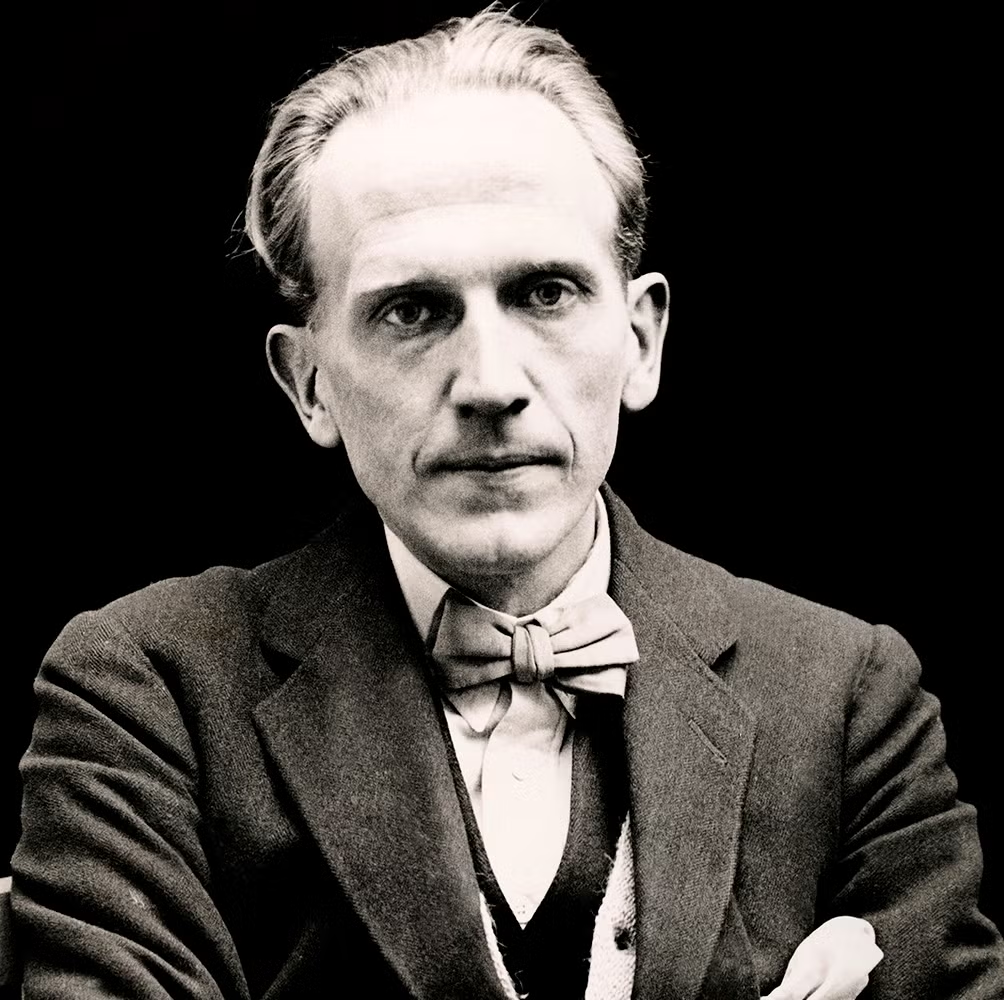
Is there any gentler set of children’s book characters than A A Milne’s Winnie the Pooh and the other inhabitants of Hundred Acre Wood? Now a hundred years old, they are still ubiquitous and loved today, and justifiably so. Alan Alexander Milne (1882–1956) was primarily a playwright before he wrote his children’s books and was a modestly successful one at that, but it is unsurprising that his plays have been somewhat overshadowed by his later success in children’s literature. The story of his characters’ inception is quite well-known but interesting nonetheless, so if you’re comfortable, I’ll begin…
Milne was of course the father of Christopher Robin Milne, upon whom the character Christopher Robin is based, and he enjoyed writing poetry inspired by his son. One day they visited London Zoo and out of all the animals there, young Christopher was particularly taken by the tame and amiable Canadian black bear Winnipeg, or Winnie for short. Christopher had a stuffed bear, originally named Edward, like a million other stuffed bears, but now he renamed him Winnie. A future star was born. The “Pooh” part came later from a nickname the very young Christopher had adopted for a local swan.
Not yet known as Pooh, the character made his first appearance in a poem, Teddy Bear, published in Punch magazine in February 1924 and republished the same year in Milne’s book of poetry When We Were Very Young. Illustrated by E H Shepard (1879–1976) we can see the recognisable character for the first time.
When We Were Very Young, First Edition
Winnie-the-Pooh was published in 1926, followed by The House at Pooh Corner in 1928. A second collection of nursery rhymes, Now We Are Six, was published in 1927. These three books were also illustrated by E H Shepard, who was of course a hugely important part of the Pooh story. Christopher Robin, meanwhile, seems to have had quite the knack for naming toy animals: his collection also included the perfectly-named Piglet, Eeyore, Kanga, Roo and Tigger. Indeed, it was only Owl and Rabbit that A A Milne himself contributed to the final grouping, though of course it was his genius to imbue all the animals with their unique characters.
The fictional Hundred Acre Wood of the Pooh stories derives from Five Hundred Acre Wood in Ashdown Forest in East Sussex, where Milne went on walks with his son. Shepard drew on these landscapes to the point that the grown-up Christopher Robin would comment: “Pooh’s Forest and Ashdown Forest are identical”. You can visit the forest today, and look out for such spots as the Heffalump Trap, Eeyore’s Sad and Gloomy Place, and the wooden Pooh Bridge where Pooh and Piglet invented Poohsticks.
The Spanish Civil War (1936–1939), fought between General Franco’s Nationalist forces and the Loyalist/Republican faction, was a pivotal conflict shaping Spain’s political landscape but also having a profound impact on the arts, given the involvement of an array of writers, artists, and intellectuals who were compelled to take a stance on this cause célèbre. Perhaps most famously, Picasso’s Guernica was a powerful anti-war painting made in response to the bombing of the small Basque town of Guernica by Nazi Germany in support of Franco. George Orwell’s Homage to Catalonia was a memoir of his time fighting in the Spanish Civil War. Miguel Hernández spent most of the war in prison and wrote a collection of poems now considered one of the finest pieces of Spanish poetry of the 20th century.
In 1936 Ernest Hemingway travelled to Spain to cover the war there for the North American Newspaper Alliance. He had already fallen in love with Spain over a decade earlier when he attended the famous bull run at Pamplona, but now he moved from being a cultural observer to an active participant in Spanish history. Three years later he completed his great novel, For Whom the Bell Tolls. Set in the Sierra de Guadarrama mountains during a Republican guerrilla operation, the novel follows Robert Jordan, a young American demolitions expert, in the International Brigades, assigned to blow up a bridge during the Segovia Offensive.
Broad in scope, the novel deals movingly with themes of loyalty and courage, of love and defeat, of identity and the complexities of moral action. “If the function of a writer is to reveal reality,” his editor Maxwell Perkins wrote, “no one ever so completely performed it.” The novel was published in 1940, just after the end of the Spanish Civil War, and is regarded as one of Hemingway’s best works, along with The Sun Also Rises, A Farewell to Arms, and The Old Man and the Sea. It stands as one of the best war novels of all time, and here are its opening lines:
He lay flat on the brown, pine-needled floor of the forest, his chin on his folded arms, and high overhead the wind blew in the tops of the pine trees. The mountainside sloped gently where he lay; but below it was steep and he could see the dark of the oiled road winding through the pass. There was a stream alongside the road and far down the pass he saw a mill beside the stream and the falling water of the dam, white in the summer sunlight.
“Is that the mill?” he asked.
“Yes.”
“I do not remember it.”
“It was built since you were here. The old mill is farther down; much below the pass.”
He spread the photostated military map out on the forest floor and looked at it carefully. The old man looked over his shoulder. He was a short and solid old man in a black peasant’s smock and gray iron-stiff trousers and he wore rope-soled shoes. He was breathing heavily from the climb and his hand rested on one of the two heavy packs they had been carrying.
“Then you cannot see the bridge from here.”
“No,” the old man said. “This is the easy country of the pass where the stream flows gently. Below, where the road turns out of sight in the trees, it drops suddenly and there is a steep gorge — ”
“I remember.”
“Across this gorge is the bridge.”
“And where are their posts?”
“There is a post at the mill that you see there.”
The young man, who was studying the country, took his glasses from the pocket of his faded, khaki flannel shirt, wiped the lenses with a handkerchief, screwed the eyepieces around until the boards of the mill showed suddenly clearly and he saw the wooden bench beside the door; the huge pile of sawdust that rose behind the open shed where the circular saw was, and a stretch of the flume that brought the logs down from the mountainside on the other bank of the stream. The stream showed clear and smooth-looking in the glasses and, below the curl of the falling water, the spray from the dam was blowing in the wind.
“There is no sentry.”
“There is smoke coming from the millhouse,” the old man said. “There are also clothes hanging on a line.”
“I see them but I do not see any sentry.”
“Perhaps he is in the shade,” the old man explained. “It is hot there now. He would be in the shadow at the end we do not see.”
“Probably. Where is the next post?”
“Below the bridge. It is at the roadmender’s hut at kilometer five from the top of the pass.”
“How many men are here?” He pointed at the mill.
“Perhaps four and a corporal.”
“And below?”
“More. I will find out.”
“And at the bridge?”
“Always two. One at each end.”
“We will need a certain number of men,” he said. “How many men can you get?”
“I can bring as many men as you wish,” the old man said. “There are many men now here in the hills.”
“How many?”
“There are more than a hundred. But they are in small bands. How many men will you need?”
“I will let you know when we have studied the bridge.”
“Do you wish to study it now?”
“No. Now I wish to go to where we will hide this explosive until it is time. I would like to have it hidden in utmost security at a distance no greater than half an hour from the bridge, if that is possible.”
“That is simple,” the old man said. “From where we are going, it will all be downhill to the bridge. But now we must climb a little in seriousness to get there. Are you hungry?”
“Yes,” the young man said. “But we will eat later. How are you called? I have forgotten.” It was a bad sign to him that he had forgotten.
“Anselmo,” the old man said. “I am called Anselmo and I come from Barco de Avila. Let me help you with that pack.”
Now, Voyager is a 1942 American movie Bette Davis, Paul Henreid, and Claude Rains, and directed by Irving Rapper. The screenplay by Casey Robinson is based on the 1941 novel of the same name by Olive Higgins Prouty, who borrowed her title from the Walt Whitman poem The Untold Want:
The untold want by life and land ne’er granted, Now, voyager, sail thou forth, to seek and find.
Walt Whitman, being one of America’s national treasures, is oft-quoted on screen and in music: O Captain! My Captain in Dead Poets Society springs to mind, and more recently Bob Dylan’s I Contain Multitudes is a line borrowed from Song of Myself. “Now, voyager, sail thou forth, to seek and find” fits the storyline well, as we’ll see.
Now, Voyager movie poster
Charlotte Vale (Bette Davis) is a shy, neurotic and overweight young woman who is in thrall to her domineering harridan of a mother (Gladys Cooper). The verbal and emotional abuse dished out to her daughter has created a woman on the verge of a nervous breakdown. Indeed, fearing just that, Charlotte’s sister-in-law Lisa introduces her to psychiatrist Dr Jaquith (Claude Rains), and Charlotte spends some time in his sanitarium. This proves to be a turning point, and away from her mother’s clutches, Charlotte blossoms, loses weight and gets herself a whole new wardrobe. Both Lisa and Dr Jaquith encourage Charlotte not to go home yet but to instead go on a cruise.
Charlotte agrees, and although initially too shy to mix with the other passengers on the ship, she meets and becomes friendly with Jerry Durrance (Paul Henreid), a married man traveling on business. Jerry is sympathetic to Charlotte’s new-found but still inchoate confidence and opens up about his own young daughter Tina and her struggles with shyness. Charlotte learns that it is only Jerry’s devotion to his daughter that keeps him from divorcing his wife, who is a manipulative and jealous woman. On an excursion from the ship in Rio de Janeiro, Charlotte and Jerry are stranded on Sugarloaf Mountain. They miss the ship and spend five days together before Charlotte flies to Buenos Aires to rejoin the cruise. Although it is clear they have fallen in love, they decide not to see each other again.
When she disembarks from the ship, Charlotte’s family is stunned by the dramatic changes in her. The formerly quiet and shy Charlotte is inundated with fond farewells from fellow passengers. Back home, her mother tries to browbeat her daughter all over again, but this time Charlotte remains resolute, empowered by her experiences aboard the ship and the memory of Jerry’s love. This time, she can fight back and when later she delivers some home truths, Mrs Vale, perhaps robbed of her raison d’être as effective virago, dies of a heart attack. Guilty and distraught, Charlotte returns to the sanitarium but is quickly diverted from her relapse by meeting Jerry’s daughter Tina and taking her under her wing.
When Tina’s condition improves, Dr Jaquith allows Charlotte to take Tina to live with her at her home to Boston, on the condition that her relationship with Jerry remains platonic. Jerry is delighted to see the improvement in his daughter, but the love he and Charlotte share must seemingly remain in check. Charlotte tells Jerry that she sees Tina as her way of being close to him. When Jerry asks her if she is happy, she delivers the classic line at the very end of the movie: “Oh, Jerry, don’t let’s ask for the Moon. We have the stars.”
Bette Davis “Before and after” in Now, Voyager
Commentaries on excellence in art, music, film, and literature